
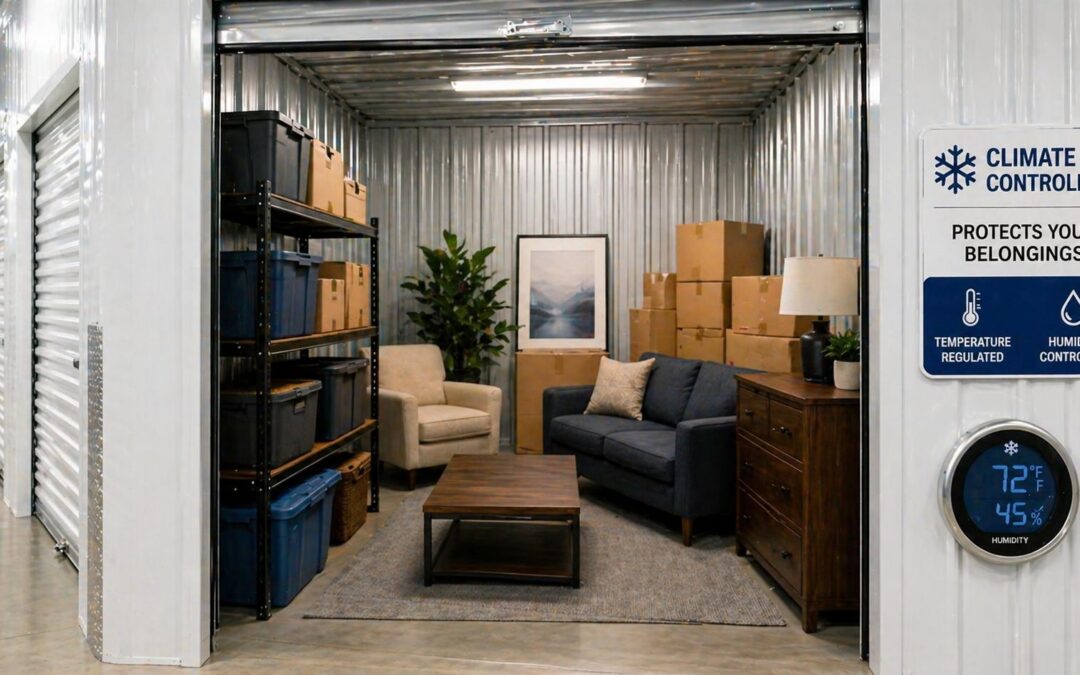
Here’s what it means at our Whitehall facility — and, more useful to you, how to tell whether you need it at all.
What we do
Every unit here is inside the building. That matters as much as the heating and cooling does, because an interior unit doesn’t share a wall with the weather the way a drive-up unit does. It isn’t sitting in the sun in August or against a snowbank in January.
The building is conditioned year-round, so it never freezes and never bakes. We also have a state-of-the-art dehumidification system that very few others can say.
What actually damages stored belongings
It isn’t cold. Cold on its own ruins surprisingly little.
It’s freezing and thawing, over and over. Our winters don’t sit at one temperature — they bounce around freezing, sometimes several times in a week. Anything with liquid in it expands when it freezes and shrinks when it thaws, and doing that thirty times is what cracks things. That’s why paint, batteries, canned goods, and anything with a seal or a glue joint fail in an unheated space.
And it’s humidity. Summer here is humid, and a closed-up metal box in August turns into a small greenhouse. Moisture collects on cool surfaces, and that’s how you get mildew on a couch, warping in a hardwood table, and mold on paper.
Here’s the part people don’t expect: in this climate, humidity does more damage than cold does — and it does it in July, not January. If you’re only thinking about winter, you’re thinking about the wrong season.
What genuinely needs it
-
Wood furniture, especially anything old, veneered, or with real joinery. Wood moves with humidity, and moving over and over opens joints and lifts veneer.
-
Couches, chairs, and mattresses. Fabric is porous, and once mildew starts, it doesn’t really come out.
-
Electronics. It’s the condensation that kills them, not the cold.
-
Paper, photos, and documents. Business records, tax files, books, artwork, letters.
-
Instruments. Anything with a wooden body is really a humidity instrument.
-
Leather. Dries and cracks, or molds, depending on which way the air goes.
-
Records, film, and old media. More heat-sensitive than almost anything else on this list.
What honestly doesn’t
We’d rather tell you this than sell you something you don’t need.
Plastic bins of holiday decorations, garden tools, metal shelving, tires, patio furniture frames, most sporting equipment — these do fine in an unheated space. If that’s your whole unit, climate control isn’t where your money should go.
The catch is that most units are mixed. One box of photo albums sitting inside eight bins of yard equipment makes it a climate-controlled unit, because the photos set the requirement. Sort by the most delicate thing you’re storing, not the average.
What it doesn’t do
No facility’s climate control is a sealed vault, and anyone who implies otherwise is overselling. Two honest limits:
It doesn’t stop pests. Conditioning the air does nothing about what comes in with your boxes. The most effective thing you can do is never store food of any kind — including sealed and canned goods and pet food — and break down cardboard you don’t need, since it’s nesting material.
It doesn’t undo damage that already started. Mildew that began in a damp basement keeps going in a conditioned unit. Clean and fully dry anything questionable before it comes in.
The simple test
Ask yourself one question:
Would I be comfortable leaving this in an unheated garage for two years?
If yes, you don’t need climate control. If you hesitated, you do.
That’s it. You don’t need a chart.
Want to see the building before you decide? Come by 2813 Lehigh Street in Whitehall, Monday through Saturday, 9am to 5pm. We’ll walk you through it and you can feel the difference yourself.
Unit access is 6am to 10pm, seven days a week. Questions: .