
get it all inside and close the door. Completely understandable. We watch it happen every week.
The trouble shows up four months later, when you need one box — the winter coats, the tax folder, your daughter’s baby photos — and it’s somewhere in the back behind a couch.
The good news is that avoiding this takes about twenty extra minutes on move-in day. Here’s what actually works.
Leave yourself an aisle
This is the big one, and it’s the one people skip.
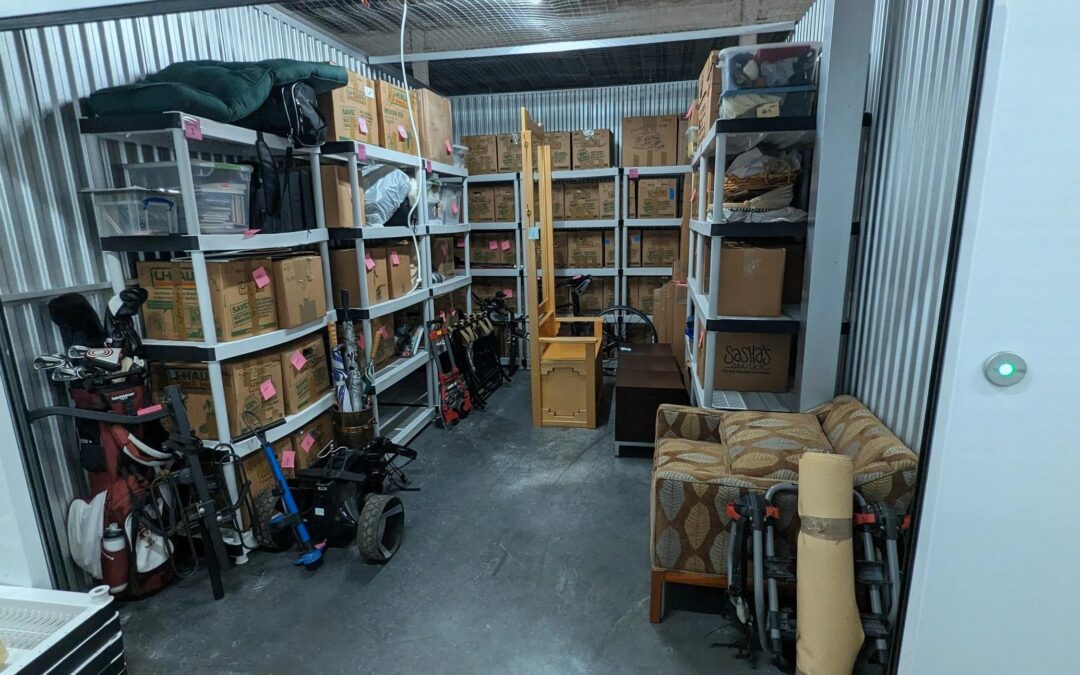
Pack along the two side walls and the back wall, and leave a walkway down the middle. Yes, it means renting slightly more space than the absolute minimum. But a unit packed wall-to-wall isn’t storage — it’s a locked room you can only unpack, never visit.
If you know you’ll never open the door until move-out day, skip this and pack it tight. You’ll save money and that’s the right call. But if you’ll be in there even once a season, the aisle is worth it.
Put the “someday” things in the back
Before anything goes in the truck, sort into two piles: things you’ll want in the next six months, and things you won’t.
Holiday decorations, off-season clothes, business records, kids’ sports gear — those go near the door. Furniture from the guest room, the old dining set, boxes you’re keeping for sentiment — those go in the back.
It takes five minutes of thinking and it’s the difference between a ten-minute visit and a ninety-minute one.
Use the same size boxes
Mismatched boxes don’t stack, and a stack that doesn’t sit flat will lean, then slide, then fall. Uniform boxes stack straight and let you go higher, which means you use the height you’re paying for instead of just the floor.
If you’re buying boxes anyway, buy one size for the bulk of it and a smaller size for books and anything heavy. Which brings us to the next thing.
Heavy on the bottom, light on top — and keep heavy boxes small
Books, tools, dishes, and files are heavier than they look. A large box full of books can hit fifty pounds, and nobody is lifting that comfortably onto a stack.
Small boxes for heavy things. Large boxes for light things like bedding and clothes. It feels backward and it’s right.
Label the sides, not the tops
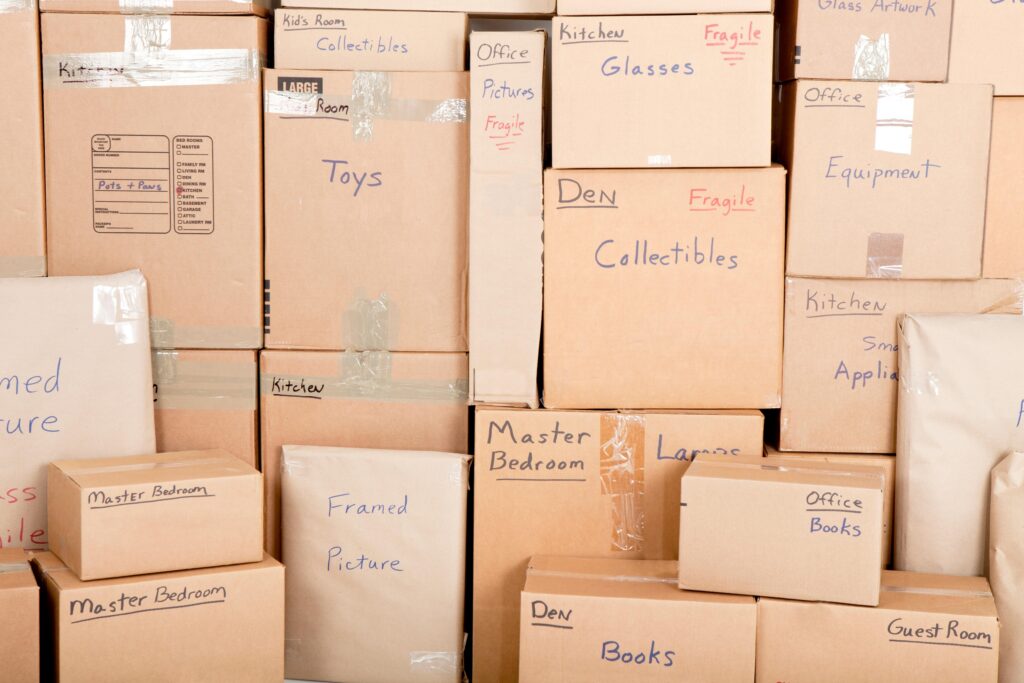
Once a box is stacked, you can’t see its top. Write on at least two sides, in marker, and be specific. “Kitchen” doesn’t help. “Kitchen — pots, baking pans, crockpot” gets you in and out.
If you want to go one step further, number every box and keep a list on your phone. It sounds like overkill. Anyone who’s done it once never goes back.
Take furniture apart, and tape the hardware to the piece
Bed frames, table legs, shelving. Disassembled furniture stores flat against a wall and takes up a fraction of the room. Put the screws and bolts in a zip bag and tape it directly to the underside of the piece they belong to — not in a box, where it will become a mystery bag of hardware in three years.
A few things that save real grief
Don’t wrap upholstery in plastic. Plastic traps moisture against fabric. Use old sheets or moving blankets so things can breathe.
Stand mattresses on their side and support them. Flat on the floor, a mattress becomes a shelf, and whatever you put on it will leave a permanent dent.
Wipe out appliances and leave the doors cracked. A sealed refrigerator or washer with a little moisture inside will smell strongly by spring.
Fill hollow spaces. Dresser drawers and empty suitcases are free storage. Put linens and light items inside.
Nothing to eat. Not sealed pantry goods, not canned food, not pet food. This is the single most common cause of a pest problem, and it’s completely avoidable.
Take a photo before you close the door
Stand at the entrance and take one wide picture. Six months from now, when you’re trying to remember whether the Christmas tree stand made it in, that photo answers the question in two seconds without a drive to Whitehall.
One last thing…
If you’re doing this in the middle of a move, a downsize, or a hard stretch — and most people are — please don’t turn this into another thing to get perfect. The aisle and the labels are the two that matter. Everything else is a bonus.
And if you get here and you’re not sure how it’s all going to fit, come find us in the office. We do this every day, and we’re glad to help you think it through.
Questions? We’re at 2813 Lehigh Street in Whitehall, Monday through Saturday, 9am to 5pm. Call us at (484) 246-6436 – you’ll get a neighbor, not a call center.
Unit access is 6am to 10pm, seven days a week.