
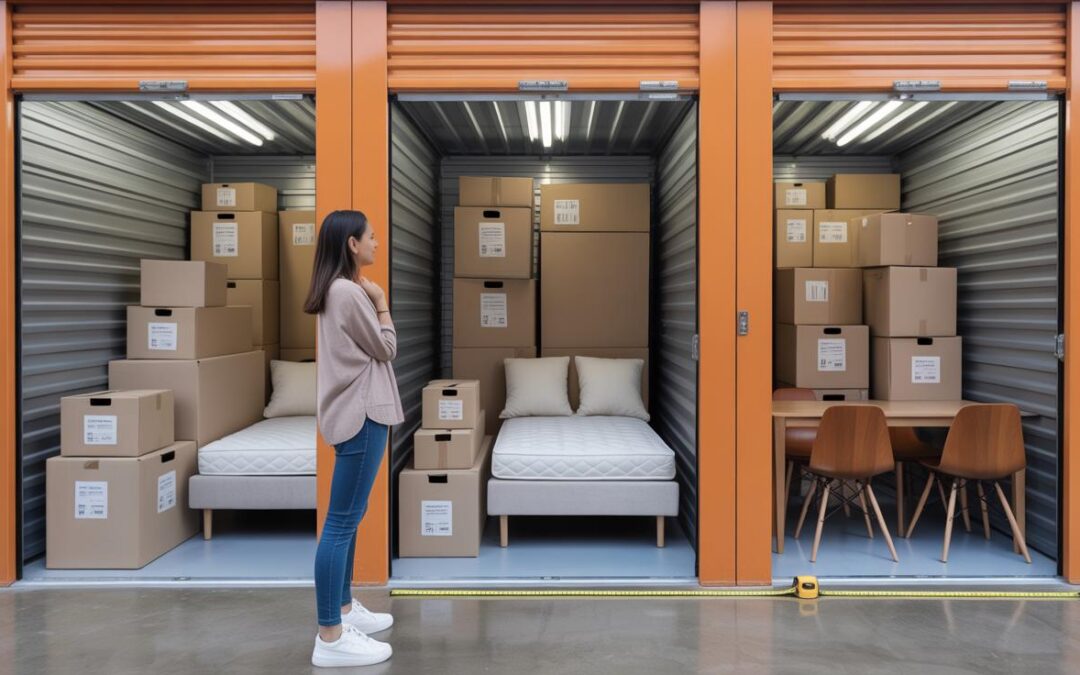
Most people rent one size larger than they need.
It’s an easy mistake to make, and an understandable one — nobody wants to drive a loaded truck across the valley and find out it won’t fit. But over a year, that extra size costs real money. So here’s a better approach than guessing.
Think in height, not just floor space
Units are described by their floor dimensions, but you’re renting a room, not a rectangle. Our ceilings run about 12 feet, and most people stack to maybe half of that.
Practically, that means a well-packed 10×10 holds about what a poorly packed 10×15 holds. Same-size boxes, stacked along the walls, will move your answer down a full size. That’s a real difference in your monthly bill.
The two-minute inventory
Before you call anyone, walk through what you’re storing and count five things:
-
Big furniture — couches, mattresses, dressers, tables, appliances
-
Boxes — roughly how many, in moving-box terms
-
Awkward stuff — bikes, treadmills, patio furniture, anything that won’t stack
-
Fragile things — anything that can’t have weight on top of it
-
How often you’ll visit
That last one matters more than people expect. We’ll come back to it.
The sizes, in plain terms
The full list is on our , but here are the four that cover most people:
5×5 — a large closet. Seasonal clothes, holiday decorations, a handful of boxes, maybe one small piece of furniture. This is the right answer far more often than people think.
10×5 — a studio apartment. Or a one-bedroom’s worth of boxes without the furniture. This is the workhorse for apartment renters who need overflow room, not a whole household.
10×10 — a one-bedroom apartment, furniture included. If you’re storing a household during a move, this is where most people land.
10×15 and up — two bedrooms and beyond. Once you’re past 10×15 you’re storing a house, and that’s a conversation better had on the phone than off a chart. Call us and describe it.
When paying for the extra room is worth it
Here’s the honest argument for going one size up.
If everything fits in a 10×10 with no room to walk, you’ve built a wall. Getting to something in the back means dragging half the unit into the hallway. If it’s all going into storage for six months during a renovation and you won’t touch it, that’s fine — pack it tight and save the money.
But if you’ll be in there twice a month pulling inventory, seasonal gear, or files, the next size up buys you an aisle down the middle. That aisle is worth the difference if it saves you forty-five minutes every visit. It’s worth nothing if you never go.
So: size to what you have, then adjust for how often you’ll be in there. Not the other way around.
When you’re just not sure
Two options, both better than guessing.
Come look. We’re at 2813 Lehigh Street, Monday through Saturday, 9am to 5pm. Standing inside a 10×10 for thirty seconds tells you more than any online calculator ever will.
Or call and describe it. Our staff sizes units all day. They’ll tell you honestly if you’re about to overbuy — including when the right answer is a smaller, cheaper unit than the one you called about. We’d rather have you as a customer for three years than sell you an extra fifty square feet today.
And if you do end up in the wrong size, you’re not stuck. As long as we have space available, moving you to a different unit is straightforward. It’s an inconvenience, not a disaster.
One more thing
If you’re sizing a unit in the middle of a move, a downsize, a divorce, or a parent’s estate — and a lot of people are — give yourself some grace on getting this exactly right. Close enough works. We’ll help you sort out the rest.
Ready to look?
Related: ·